
The Dynamic Pace & Compression Tracker
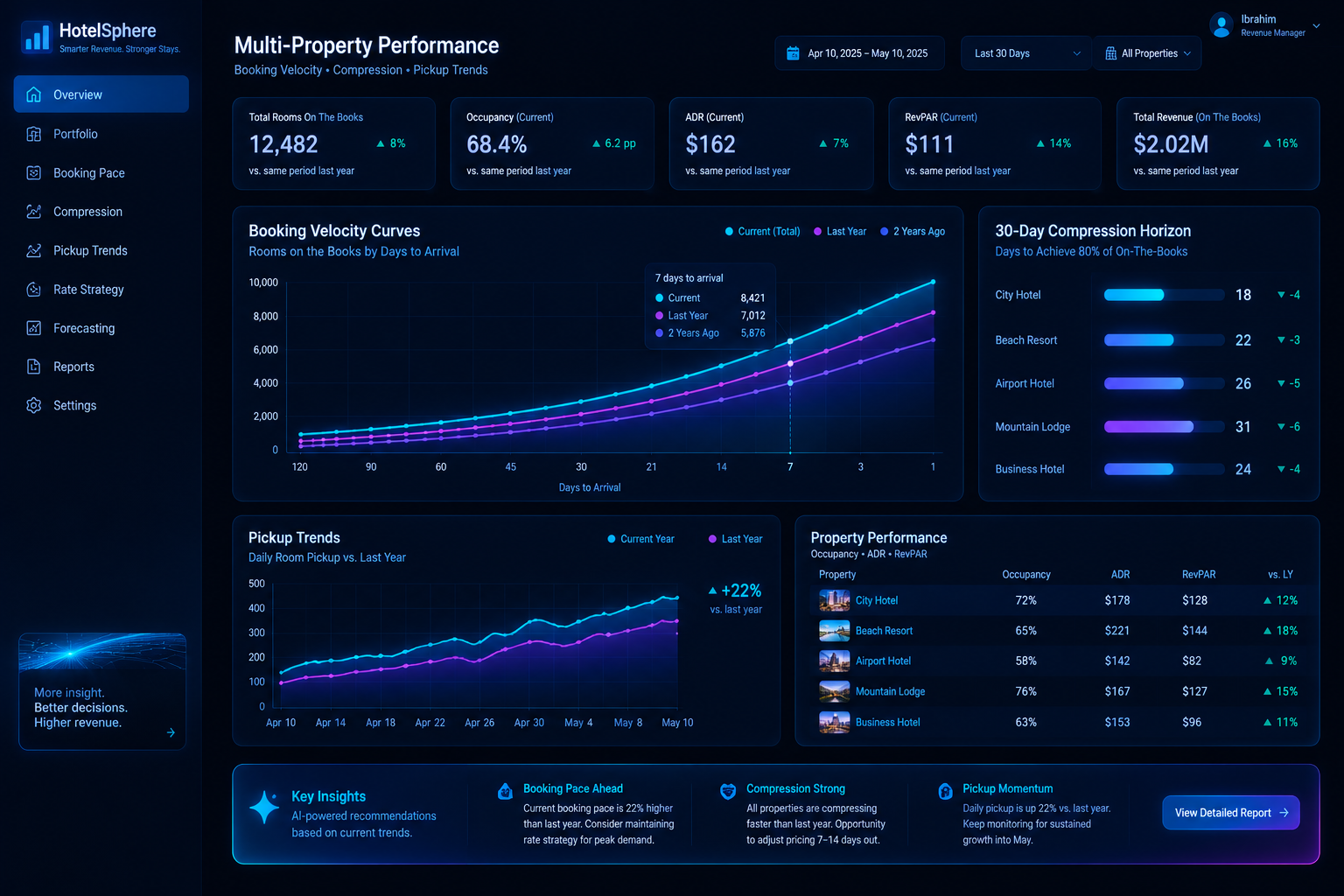
Tracking booking velocity against historical curves is essential for maximizing yield during high-compression periods. Across our 756 keys spanning Novotel, Adagio, and Mercure, standard PMS pacing reports often obscure short-term compression spikes until it is too late to adjust pricing.

01 // The Pacing & Compression Dilemma
When managing regional events and exhibitions in Abu Dhabi, commercial teams frequently encounter sudden surges in demand. Relying purely on final occupancy percentages without tracking Day-over-Day (DoD) velocity curves leaves revenue managers blind to whether pace acceleration is driven by low-rated leisure groups or high-paying corporate transient demand.
Without a synchronized tracking mechanism comparing current On-The-Books (OTB) figures against Same Time Last Year (STLY) benchmarks, pricing adjustments risk being reactive rather than proactive, leading to premature sell-outs or lost ADR potential.
02 // The Solution: Automated Pace & Curve Model
To bridge this gap, I developed an advanced Excel pacing matrix that pulls historical booking curves and overlays live OTB data using dynamic lookup formulas. The model automatically flags compression dates where current pickup velocity exceeds historical thresholds by more than 15%, prompting immediate hurdle rate updates.
This dynamic framework normalizes variances between extended-stay demand patterns at Adagio and traditional transient peaks at Novotel and Mercure, giving leadership an instant, unified view of portfolio demand health.
| Property | Occupancy OTB | Velocity vs STLY | Recommended Action |
|---|---|---|---|
| Novotel | 84% | +12% (Accelerating) | Close lower tiers, raise BAR |
| Adagio | 79% | +5% (Stable) | Maintain length-of-stay controls |
| Mercure | 88% | +19% (High Compression) | Apply strict arrival restrictions |
| Property | Occupancy OTB | Velocity vs STLY | Recommended Action |
|---|---|---|---|
| Novotel | 96% | +24% (Peak Demand) | Maximize premium suite pricing |
| Adagio | 91% | +18% (Strong) | Enforce 3-night minimum stay |
| Mercure | 94% | +21% (Peak Demand) | Maximize hurdle rates |
| Property | Occupancy OTB | Velocity vs STLY | Recommended Action |
|---|---|---|---|
| Novotel | 32% | +2% (On Curve) | Open early bird promotional blocks |
| Adagio | 41% | +6% (Leading) | Protect corporate negotiated rates |
| Mercure | 28% | -1% (Lagging) | Review group tentative pipeline |
03 // Strategic Impact & Takeaways
By establishing an automated pace tracking matrix, commercial teams eliminated guesswork during high-demand event windows. Catching compression spikes early allowed us to proactively adjust hurdle rates and restrict discount channels, directly contributing to accelerated ADR growth across the portfolio.
Pacing isn’t just a static report—it is an early warning system. When connected to robust historical curves, it empowers revenue leaders to capture maximum value from every single room night.
References & Methodological Framework
The pacing models and compression methodologies outlined in this case study align with leading industry standards:
- [1] HSMAI Revenue Management Standards: Guidelines on booking velocity curves, demand compression thresholds, and dynamic pricing adjustments.
- [2] IDeaS G3 RMS Pacing Analytics: Advanced principles for tracking On-The-Books (OTB) pickup against Same Time Last Year historical baselines.
- [3] Oracle OPERA Cloud PMS: Data export standards for automated reservation pace reporting and segment forecasting.